
Outline of the event:
A trip around the Mackay region visiting areas associated with significant history of the Yuibera people, the traditional owners of the land in which Mackay is located.
The places that will be visited include:
- The diversity board walk and the Yuibera plant trail located at Cape Hillsborough National park;
- The Leap and;
- The South Sea Islander Hut
The route that will be taken is shown on the Map to the right.
Cape Hillsborough National Park:
First stop will be Cape Hillsborough National park. At Cape Hillsborough participants will complete two short bush walks, the diversity board walk and the Yuibera plant trail.
These trails offer the opportunity to understand the innovations and skills that the Yuibera people used to live off the land. The walks highlight the traditional use of plants, fish traps and how to live sustainably with the marine environment (Department of Parks, Sport and Racing 2012).
This area is of importance as it establishes the independence of the Yuibera people before European settlement (Broome 2010). It also highlights the unique flora and fauna within Australia, which requires a unique approach to live off sustainably. This is something the Australian farming industry is starting to recognise (Wilson 2014).
The Leap:
Following the Cape Hillsborough walks, lunch will be held at the Leap. While here participants will have the opportunity to explore the surrounding area and discuss the events that have made this site notorious in the Mackay region.
The common tale of the Leap is as follows:
An Aboriginal woman was trying to escape Native Mounted Police and ran to the top of Mt Mandarana. Rather then be captured by them she leapt from the top of the cliff, with her baby in arms. Miraculously the baby survived the fall due to the shawl it was wrapped in becoming caught on a bush. The baby was taken in by a local family and ended up becoming a talented singer (Mackay Historical Society and Museum Incorporated 2004).
This story is different to what historical documents show the situation to have been. It is estimated that prior to settlement there were in excess of 1000 Aboriginal’s living in the Mackay region (Moore 1990). Due to methods used in frontiers districts, shooting, poisoning and death from introduced disease, by the 1860s this number was halved (Richards 2014). Aboriginal-European relationships had been tense for a long time and reached a boiling point in Febuary1867 when 2 cattle where found speared on Balangowan Station, one dead and one injured (Moore 1990). John Cook, the station owner, sent for the Native Police who arrived in April 1867. During their time patrolling the area they came across several Aboriginal camps, one with upwards of 200 inhabitants (Moore 1990).
The Native Police set about ‘dispersing’ the Aboriginals living in the area. At the top of the Leap there are caves that were used by Aboriginal people. It is believed that in an attempt to escape the massacre that was occurring, a group sought shelter in them. The Native Police followed and provided the option to face the trooper’s carbines or to jump over the cliff (Moore 1990). There is no record of the exact number of those who were shot at point blank range and those who were forced to jump (Richards 2014). However, it is clear that a female, most likely 2 to 3 years of age, survived and was taken in by a local family, the Ready’s (Moore 1990).
As it stands the commonly told history of the leap is factually incorrect, leaving out many key points around what really occurred. Aboriginal culture is one based on storytelling. The Dreaming involves stories that tell the history, law and cultural values and beliefs to be passed from one generation to the next through song, dance, painting or storytelling (Broome 2010). This makes it particularly inappropriate that the stories about Aboriginal’s and their history throughout the settlement of Australia so often have facts distorted, changed or removed completely. The acknowledgement of this site for the massacre that occurred, rather than a novel tourist attraction, is an important part of the reconciliation process and in turn will help contribute to closing the gap (Lemelin et. al. 2013).
South Sea Islander Hut:
Finally, the day will conclude by visiting the South Sea Islander Hut at the Mackay botanic gardens, with afternoon tea at the gardens café to debrief.
While South Sea Islanders are not Indigenous Australians the Mackay region has a unique community in relation to South Sea Islanders. Mackay has the largest population of South Sea Islanders within Australia (Moore 2004).
The islanders were originally brought over as slaves and then as indebted workers to work the cane fields (Moore 2004). The work was dangerous with on average 50 out of every 1000 workers dying. This is compared to a death rate of 9 to 10 out of every 1000 Europeans (Miller 2010). Initial relationships between South Sea Islanders and Aboriginals were hostile. Over time this relationship changed to a positive one, helped by marriages between the two cultures and common colonial experiences (Moore 2004).
As the quest for a white Australia gained momentum, deportation of South Sea Islanders began in 1901. By 1908, 7068 South Sea Islanders had been deported. If a South Sea Islander could prove they faced danger by returning home they were allowed to remain. Around 1500 were officially allowed to stay and another 1000 remained illegally, often helped by local Aboriginal’s.
South Sea Islanders who remained faced a racist colonial society. They were regarded as inferior and legislation was aimed at controlling them and eventual deportation. The humanitarian concerns that allowed them to stay did not improve their treatment within Australia (World Directory of Minorities and Indigenous Peoples 2005). As time went on South Sea Islanders’ ability to work diminished with the introduction of policy in 1903 that provided a bounty to cane farmers who had an all-white work force (Moore 2004). Ten years later the Queensland government introduced legislation that required all non-white workers to hold a certificate of exemption that allowed them to work on farms. South Sea Islanders where prohibited from obtaining an Australian Workers Union membership until the 1970s (Moore 2004).
This treatment made it almost impossible for South Sea Islanders to make a living. The long term result was that South Sea Islanders ended up living on the edge of prosperous farming towns with growing socioeconomic disadvantages (Miller 2010).
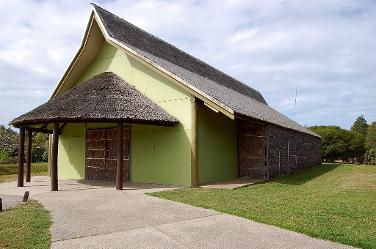
South Sea Islander Hut, Mackay
Between the 1860’s and 1890s the original Aboriginal population had be greatly reduced by deliberate culling and disease (Richards 2014). The remaining Aboriginal community were placed by Europeans into the South Sea Islander Community, thus creating a single black community (Moore 2004).
Fast forward to the present day and the three cultures in Mackay, Aboriginal, Torres Strait and South Sea Islander are now intertwined throughout the community, through sport, religion, marriage, education and community events (World Directory of Minorities and Indigenous Peoples 2005). It is not uncommon to meet people who have duel or triple cultural backgrounds. As such it is important to recognise the South Sea Islander community in order to fully represent the indigenous history of Mackay (Miller 2010).
